

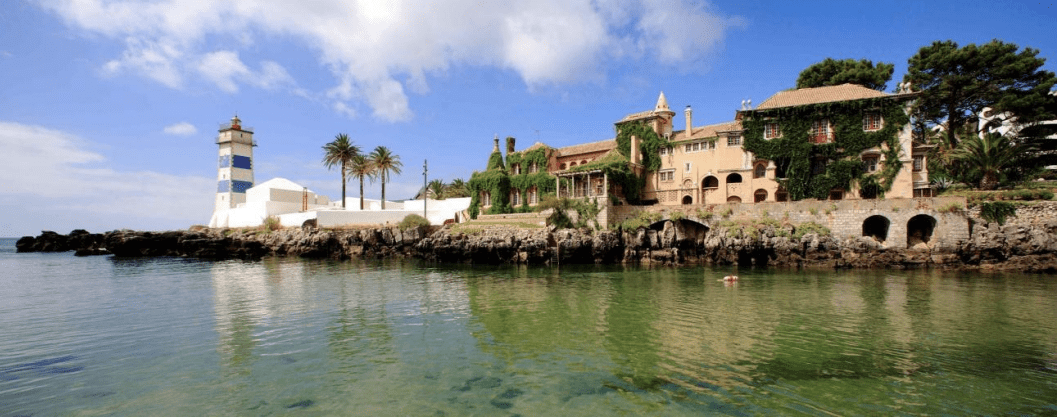
Cascais and the Irish Connection

Portugal’s history has been connected to Ireland for many, many years, and Cascais is no exception, and here one will find, in every corner, an Irish touch that reminds us of the long alliance and cultural similarities of these
two countries.
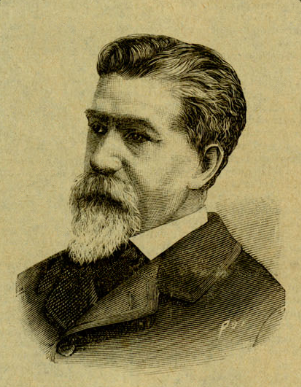
The greatest example of the passion for Portugal and Cascais that awakens the soul of so many Irish people is an Irishman, Jorge O’Neill.
Jorge Torlades O’Neill (Lisbon, Encarnação, 15 February 1849 – 11 February 1925) was the titular and official head of the Clanaboy O’Neill dynasty, whose family has been in Portugal since the 18th century.
He called himself Count of Tyrone; he presented on the Portuguese Cartory of the Nobility several documents proving his illustrious origin, of which the Clerk of the Nobility passed him a Certificate on 30 June 1902. He was recognised as the
Chief of his name by the Somerset Herald, Sir
Henry Farnham Burke, in 1896. The Chief Herald of Ireland recognised his grandson as O’Neill of Clanaboy.
Jorge Torlades O’Neill II was an Honorary Officer-Major of the Royal Household and a man connected to politics (deputy since 1887), finance, and the tobacco industry. He was also a personal friend of King Carlos I of Portugal.
“Rely solely in heaven” was the watchword of this family of irish catholics that emigrated to Portugal in 1740 due to the violent enmity with protestants.
It is worth noting that, as a result of donations or acquisitions, the Cascais city hall now owns 3 buildings commissioned by Jorge O’Neill at the turn of the century, built as private or family residences.
These buildings are undoubtedly 3 of the most important architectural works erected in the municipality in the wake of Cascais’s transformation into a holiday resort from the end of the nineteenth century onwards.
The buildings are now open to the general public as museums and leisure areas.
Please check our Irish itinerary suggestion for a future visit to this beautiful area
Morning visits
– Walking tour in the centre of Cascais, from the promenade to the citadel.
Recommended stops:
- Casa de Santa Maria – Santa Maria House and Museum
- The Santa Maria House was built in 1902 by the orders of Jorge O’Neill and is situated on the Cascais Bay.
- The project was designed by the Portuguese architect Raul Lino.
The decorative richness of this house can be appreciated in its 17th-century tile panels and the magnificent oil-painted wooden ceiling, reused after the dismantling of an old chapel.
The existence of such a rich and diversified collection of tiles – panels, such as the Purification of Our Lady, the Flight into Egypt, the Virgin with Jesus and St. John the Baptist as boys, the Circumcision, Jesus among
The Doctors, Our Lady Sewing, and the painted wooden ceilings reveal indisputable patrimonial value, as they belong to the Portuguese Baroque artistic repertoire.
Currently, the space regularly hosts conferences and temporary exhibitions.
Hours: Tuesday to Sunday from 10 a.m. to 1 p.m. and from 2 p.m. to 5 p.m.
Museu Condes de Castro Guimarães
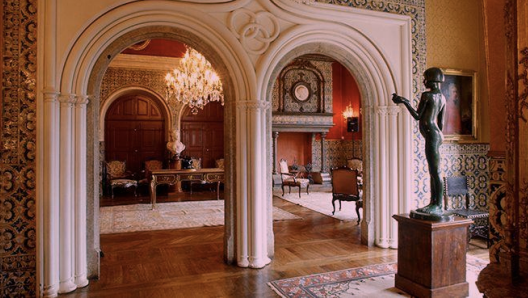
Surrounded by a beautiful garden, the Tower of S. Sebastian, the current Library-Museum Condes de Castro Guimarães dates from the early twentieth century and was built on the initiative of the aristocrat Jorge O’Neil. Outstanding work of romantic architecture, the Tower of S. Sebastian
fascinated by the mix of styles and the surrounding mysticism that makes you wonder about stories of other times.
Main rooms:
– The Clovers Room
The name comes from this room, with painted clovers adorning the ceiling, representing the symbol of Ireland, the country of origin of O’Neil, the first owner of the Tower of San Sebastian.
– Turret / Gun Room Space dedicated to the presentation of the Museum’s collection of armoury and highlighting the richly decorated ceiling with the coats of arms of the ancestors of Mr O’Neil.
– The Library
Composed by the bibliographic legacy given by the Count of Castro Guimarães, this collection brings together works concerning the Universal History, History of Portugal, Music, Seamanship and Romance,
among others. In this room stands out the most emblematic and valuable collection of the Museum: the manuscript “Chronicle D. Afonso Henriques” written by Duarte Galvão, from 1505, in which it
is noted the first known depiction of Lisbon, by António d’Ollanda.
In 1910, as Jorge O’Neill went bankrupt, he sold this house to the counts of Condes de Castro Guimarães.
Hours: Tuesday to Sunday from 10 a.m. to 1 p.m. and from 2 p.m. to 5 p.m.
Afternoon visits
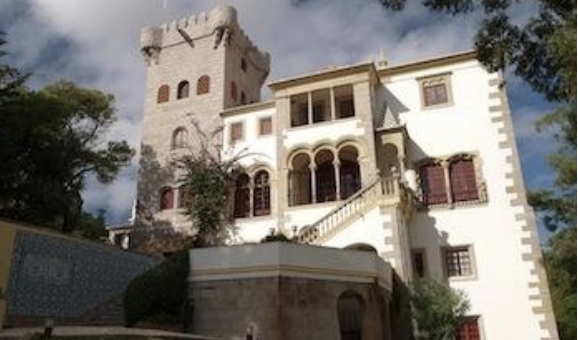
Casa Verdades Faria – Portuguese Music Museum
Located in “Monte Estoril” (between Estoril and Cascais), this museum, also known as St. Patrick’s tower, is an excellent example of the so-called
“summer residence architecture” that characterised this region’s building heritage in the late nineteenth and early twentieth centuries.
The house was the result of a commission by Jorge O’Neill in 1918. O’Neill’s romantic ideal was
to build here a tower (St. Patrick’s tower). The work was completed two years later, which
reveals the considerable financial resources allocated to the project.
In privileged circumstances, Raul Lino designed a unique heritage building in the municipality of Cascais, wherein the singularity of the main building was allied to a woodland, which currently constitutes an
important reminder of the dense pine grove that once covered the area. The small palace comprises three essential spaces: the neo-medieval tower, the house itself, and the cloister.
The building as a whole also includes a chapel with a neo-Gothic vaulted ceiling and a full-scale statue of St. Patrick on the altar, sculpted by Anjos Teixeira.
The property was assigned to the municipal council in 1974, subject to the condition that it would be transformed into a public garden and house-museum, now dedicated to Portuguese music.
The Portuguese Music Museum develops a set of actions in research, conservation, documentation, communication and education, presenting a cultural program with temporary exhibitions, cycles of
concerts, lectures, educational programs and also promotes the Lopes-Graça Composition Award annually.
In 2005, the museum underwent an extensive restoration and remodelling, and reopened to the public with a new museum programming and a wide range of initiatives related to the
promotion of the work of the composers Giacometti and Lopes-Graça.
Hours: Tuesday to Sunday from 10 a.m. to 1 p.m. and from 2 p.m. to 5 p.m.
Other suggestions:
- – Stop at the viewpoint of the “Mouth of Hell” (Boca do Inferno) in the coastal road Cascais – Guincho.
- – Have a drink at the Irish Pub O’Neills, in its terrace with spectacular views of the sea, located in front of Cascais bay.
- – End your tour with an afternoon tea at the popular cake shop “Garrett”, located near Estoril’s train station. Full of history and not only of wonderful cakes, this was a meeting place for numerous
International spies who populated Cascais during the Second World War, highlighting the presence of writer Ian Fleming, who at the time served the British Secret Service.
