

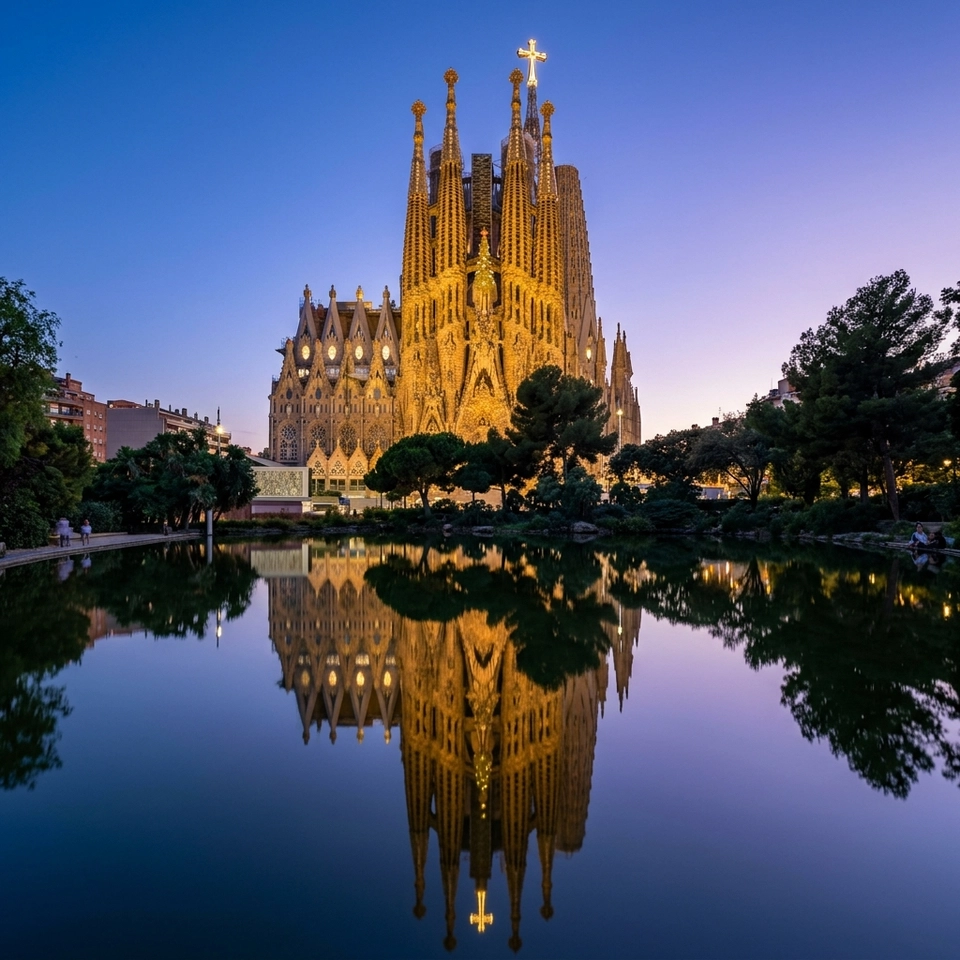
Sagrada Família Finally Reaches Completion
After more than 144 years of construction, Barcelona’s Sagrada Família has reached the defining milestone that generations of visitors, architects and worshippers had been waiting for: the completion of its central structure.
The basilica’s final major structural element was installed atop the Tower of Jesus Christ in February 2026. The addition brought the building to its planned height of 172.5 metres, completing the six central towers and making the Sagrada Família the tallest church in the world. The moment came in the centenary year of the death of Antoni Gaudí, the visionary architect who devoted the latter part of his life to the project.
A dream that outlived its architect
Construction began in 1882, initially under the direction of architect Francisco de Paula del Villar. Gaudí took over the project the following year and transformed it into the extraordinary work now recognised around the world. Rather than treating the basilica as a conventional building, he imagined it as a vast theological and natural composition: a forest of columns, towers reaching towards heaven, and façades filled with scenes from the life of Christ.
Gaudí understood that the work would extend far beyond his lifetime. His response was not to simplify the design but to create models, drawings and structural systems that could guide future generations. He is often associated with the idea that his client—the divine—was not in a hurry. Whether repeated as an anecdote or interpreted as a design philosophy, the sentiment captures the unusual patience built into the project.
Gaudí died in 1926 after being struck by a tram, when only part of the basilica had been completed. His death left the project without its original creator, but not without direction.
The long road to the skyline
The Sagrada Família’s construction was interrupted by political upheaval, financial uncertainty and the Spanish Civil War. In 1936, anarchists broke into the building’s workshop and destroyed many of Gaudí’s original plans and models. Later architects had to reconstruct elements of the design from the surviving material, photographs and fragments.
The basilica has always been funded largely through donations and visitor contributions. That funding model helped preserve the project’s independence, but it also meant that progress depended on the number of visitors and the resources available at any given time. Modern digital modelling, computer-aided fabrication and advances in stone engineering eventually accelerated work that once relied almost entirely on handcraft and physical models.
The result is a building in which medieval traditions and advanced technology coexist. Stone components can be designed digitally, tested precisely and produced with a level of accuracy that Gaudí could not have possessed, while artisans continue to finish surfaces and details by hand.
The Tower of Jesus Christ
The final major structural achievement centred on the Tower of Jesus Christ, the basilica’s highest and most symbolically important tower. Its completion established the vertical hierarchy that Gaudí had planned: the central tower rises above the towers dedicated to the four Evangelists, while the remaining towers represent the Virgin Mary and the twelve Apostles.
At the summit, the cross is not merely a decorative feature. It completes the tower’s religious symbolism and provides the visual conclusion to the basilica’s upward movement. From the streets of Barcelona, the finished tower changes the city’s skyline; from the building itself, it confirms the logic of a design that has been taking shape for more than a century.
Is the Sagrada Família completely finished?
The answer depends on what is meant by “finished”. The completion of the central structure and the Tower of Jesus Christ marks the end of the basilica’s principal construction phase. It is the milestone most people mean when they say that the Sagrada Família has finally been completed.
However, detailed work, conservation, interior finishing and aspects of the surrounding Glory façade may continue beyond the structural completion. This distinction matters because the Sagrada Família was never simply a collection of towers. It is a complete architectural programme involving façades, sculpture, inscriptions, interior spaces, lighting and religious use.
In that sense, the basilica’s completion is not a single instant but a transition: from an unfinished construction site to a living monument whose details will continue to be maintained, interpreted and experienced.
A building shaped by time
The Sagrada Família is remarkable not only because it took so long to build, but because its long construction became part of its meaning. It connects the nineteenth-century ambitions of Gaudí with the technologies of the twenty-first century. It bears the marks of interruption, reconstruction and debate. It is both a historical work and a contemporary one.
For Barcelona, the completion is a moment of civic and cultural importance. The basilica has long been the city’s most recognisable landmark, drawing millions of visitors and shaping the international image of Catalan modernism. Its finished skyline now offers a view that Gaudí imagined but never saw.
For architecture, the achievement demonstrates that a building can survive the loss of its creator and still remain coherent. That survival depended on generations of architects, sculptors, engineers, stonemasons, administrators and donors. Each contributed to a project whose timescale would have been unthinkable for most modern developments.
Gaudí’s unfinished message, finally visible
When the final major piece was placed high above Barcelona, it did more than close a chapter in the basilica’s construction. It made visible a conversation between the past and the present: Gaudí’s designs, the work of those who preserved them, and the modern techniques that allowed the most ambitious elements to be realised.
The Sagrada Família has reached its structural finish, but its story has not ended. Buildings are never experienced only as completed objects. They change as cities change, as new generations interpret them and as visitors encounter them for the first time.
After 144 years, the Sagrada Família finally stands at the height its architect intended. Yet its most enduring achievement may be that it has made time itself part of the architecture.
